

1. Establishing High-Fidelity Pose Estimation Annotation Protocols
Training a robust model for sports movement analysis requires far more than casual bounding boxes or loose keypoint placements. In high-velocity athletic movements—such as a pitcher’s late cocking phase, a sprinter’s drive phase, or a basketball player’s landing mechanics—a discrepancy of just 15 pixels at the knee or elbow joint can distort calculated joint angles by several crucial degrees. When developing a sports movement dataset, engineering teams must codify unambiguous annotation conventions before a single frame is processed.
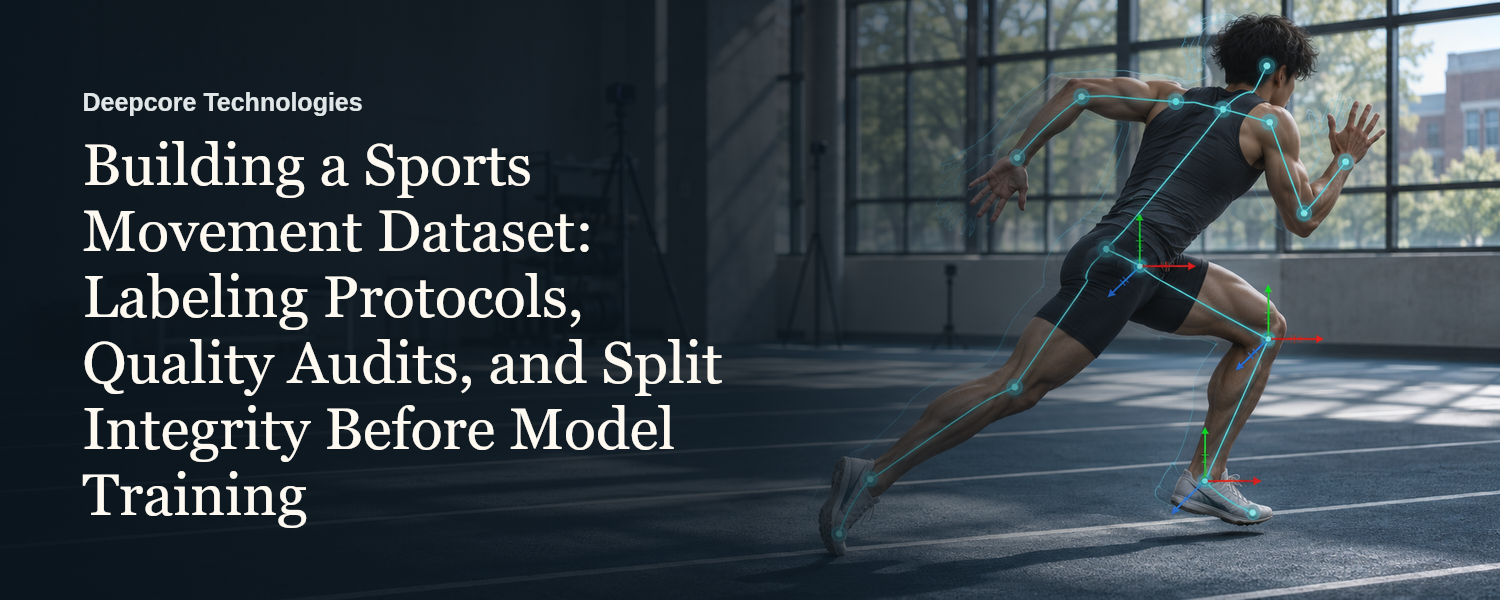
Defining Skeletal Topologies and Keypoint Anchors
Off-the-shelf topologies like COCO (17 keypoints) or standard body-tracking models (33 keypoints) often fall short of sport-specific biomechanical demands. Sports engineering teams must standardize definitions for:
- Joint Centers vs. Surface Landmarks: Specify whether annotators should identify the palpable anatomical joint center (e.g., center of the femoral condyles) or the visible surface contour. Biomechanical validity requires internal joint center estimation.
- Segmental Orientation Vectors: For rotational tracking (such as pelvic-lumbar sequencing or forearm pronation), include auxiliary orientation markers (e.g., ASIS, PSIS, acromion processes) rather than relying exclusively on midpoints.
- Occlusion and Out-of-Frame Handling: Establish a three-tier visibility flag:
visible(directly observed),occluded-estimated(inferred using kinematic continuity and physiological range-of-motion constraints), andout-of-frame(explicitly excluded). Never permit annotators to place speculative markers where motion constraints cannot mathematically justify them.
Temporal Consistency in High-Frame-Rate Video
Athletic movement occurs in continuous time. Annotating discrete, randomized frames introduces high-frequency temporal jitter that wrecks downstream velocity and acceleration calculations in movement analysis AI.
- Mandate sequential batch annotation across multi-frame micro-sequences (e.g., 60 fps to 240 fps clips).
- Implement forward-backward kinematic playback during human audits to catch momentary joint-flipping (e.g., left-right knee swap during twisting aerial actions).
- Quantify label quality with target metrics such as Percentage of Correct Keypoints (PCK@0.05) and Mean Per Joint Position Error (MPJPE) measured against multi-camera consensus or optical motion capture baselines.
2. Curating Athlete Diversity and Mitigating Biomechanical Bias
Computer vision models trained predominantly on collegiate male athletes frequently fail when deployed in youth sports, master's athletics, or diverse female cohorts. Biomechanical bias degrades not only predictive accuracy but also the clinical safety of performance-tracking algorithms.
Anthropometric and Morphological Representation
A balanced dataset must explicitly categorize and stratify participants across distinct anthropometric spectra:
- Limb-to-Torso Ratios: Disproportionate limb lengths directly alter apparent joint angles in monocular 2D perspectives.
- Body Mass Index and Soft Tissue Artifact: Increased soft-tissue deformation (wobbling mass) around thighs, glutes, and shoulders obscures underlying skeletal architecture, demanding targeted model exposure.
- Skill-Level Variance: Elite athletes demonstrate minimal movement variability and textbook motor patterns. Novice or intermediate athletes exhibit compensatory motions, asymmetries, and uncontrolled joint collapse (e.g., dynamic knee valgus), which models must recognize without misclassifying keypoints.
Environmental and Acquisition Diversity
To achieve production resilience, your pose estimation annotation pipeline must account for sensory interference:
- Apparel Diversity: Train across skin-tight compression wear, loose basketball jerseys, track spikes, heavy cleated footwear, and varied footwear heel-to-toe drops.
- Illumination and Glare: Capture both indoor hardwood glare from high-bay LED floodlights and erratic outdoor shadows on turf.
- Camera Intrinsics and Angles: Avoid standardizing on a single capture rig. Incorporate variable focal lengths, varying shutter speeds (to simulate motion blur), and elevations ranging from ground-level sideline cameras to elevated stadium vantage points.
3. Data Governance, Biometric Permissions, and Athlete Rights
Human movement recordings constitute biometric data. Under frameworks such as the European Union’s General Data Protection Regulation (GDPR, Article 9) and the California Consumer Privacy Act (CCPA), skeletal movement traces linked to identifiable faces or contextual metadata qualify as sensitive personal information.
Decoupling RGB Feeds from Kinematic Vectors
To protect participant identity and minimize enterprise risk:
- Pipeline Decoupling: Ingest raw RGB video into a zero-retention, encrypted sandbox where automated face and identity blurring occurs immediately.
- Vector Anonymization: Store skeletal coordinate vectors (
x, y, z, confidence, timestamp) separately from raw video archives. Coordinate data stripped of identifiable biometric facial features significantly reduces regulatory overhead under downstream commercial deployment. - Granular Consent Architecture: Athlete consent must specifically authorize AI training, model parameter derivation, and potential commercial deployment—not merely generic "video recording for coaching purposes."
Rights Management in Youth and Institutional Settings
When gathering data via clubs, academies, or scholastic institutions, standard single-party waivers are legally insufficient. Product teams must implement dual-signature parental consent workflows and contractually delineate intellectual property ownership regarding derived kinematic profiles versus proprietary athlete performance metrics.
4. Preventing Leakage: Subject-Disjoint Validation and Temporal Splitting
The most pervasive error in sports computer vision benchmarks is data leakage caused by random frame splitting. When frames from the same athlete, performing the same movement drill within the same session, appear in both the training and test splits, reported validation accuracy will appear stellar while real-world generalization fails catastrophically.
Designing Subject-Disjoint Partitions
- Strict Identity Separation: Ensure that no participant (by unique ID) in the test or validation set ever appears in the training set.
- Drill and Session Stratification: Even across distinct subjects, avoid assigning identical routines from the exact same day or facility exclusively to a single split. Balance equipment setups across train, val, and test partitions.
- Out-of-Distribution (OOD) Stress Splits: Allocate a distinct test partition containing unseen camera angles, unfamiliar sport-specific gear, and novel athlete body types to measure true model decay outside the comfort zone.
Preventing Temporal Leakage in Video Sequences
When training recurrent networks, temporal convolutional networks, or spatial-temporal graph neural networks (ST-GNNs):
- Never slice overlapping temporal sliding windows across the boundary of validation splits.
- Ensure a minimum "buffer epoch" (e.g., several unannotated minutes or separate sessions) between trials of identical movements to eliminate spatial background memorization.
5. Deployment Readiness: Discrepancy Audits and Team Handoff
Before greenlighting a dataset for production training, run structured inter-annotator audits. Calculate Fleiss’ Kappa for discrete visibility flags and MPJPE for coordinate variance across a blinded 10% consensus set. If two human annotators cannot agree on a joint's location within 5 millimeters or 8 pixels, the model cannot be expected to learn consistent physics.
Adaptable Template: Participant Data Collection & Biomechanical Capture Notice
Use the following standardized memo to brief coaching staffs, athlete participants, and operational coordinators prior to movement capture sessions:
MEMORANDUM: BIOMECHANICAL DATA COLLECTION PROTOCOL & DATA RIGHTS
TO: [Coaching Staff / Participant / Athletic Department]
FROM: [Product Team / Engineering Lead, Deepcore Technologies]
DATE: [Insert Date]
SUBJECT: Movement Capture Protocol & Informed Biometric Usage for [Sport / Action Focus]
- SCOPE AND PURPOSE Deepcore Technologies is conducting high-precision motion capture for [Target Movement, e.g., Pitching Delivery / Jump Landing] to advance our movement analysis AI models. Sessions will take place at [Location] on [Date Range].
- DATA COLLECTED
- High-speed digital video (up to [e.g., 120/240 fps]) from [e.g., 3-camera synchronized viewpoints].
- Anthropometric measurements: Height, arm span, limb segments, and footwear specifications.
- PRIVACY AND ANONYMIZATION SAFEGUARDS
- Raw video assets will undergo automated facial de-identification within [e.g., 72 hours].
- Extracted pose estimation annotation coordinates will be decoupled from your name and stored under an anonymized participant ID (e.g., SUBJ-[XXXX]).
- No raw identifiable video footage will be published publicly without express, written supplemental consent.
- PARTICIPANT RIGHTS Participation is entirely voluntary. You may request deletion of raw video files up until the point of model feature extraction by contacting [Insert Privacy Email].
Authorized Signature: _______________________ Date: _______________
Participant / Guardian Name: ____________________________________