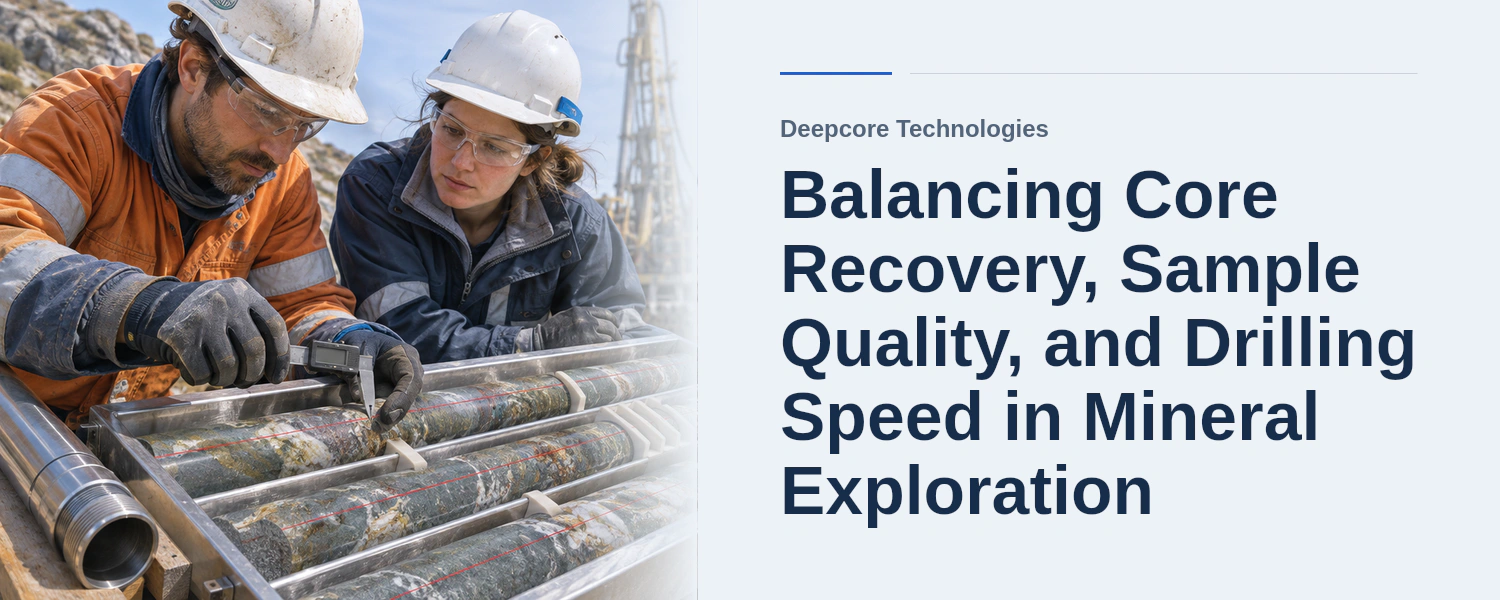


Defining Exploration Objectives: Why Speed Without Recovery Destroys Asset Value
In mineral exploration, meters drilled without usable geological evidence represent sunken capital. When project owners push for aggressive advance rates without strict controls on sample integrity, the primary casualty is the geological confidence required for resource estimation under international reporting codes such as JORC, NI 43-101, or SAMREC. A high-speed exploration drilling programme that returns washed-out core, pulverized friable structures, or biased fines undermines the financial valuation of the entire deposit.
Assessing progress requires evaluating drilling productivity against sample utility. A diamond drill rig advancing at 45 meters per shift with only 65 percent core recovery in mineralized fault gouge creates irreversible data gaps. The economic penalties of low core recovery include:
- Downgraded resource classification: Inferred resources cannot be upgraded to Indicated or Measured status if sample loss occurs preferentially in higher-grade, altered, or fractured zones.
- Misinterpreted structural architecture: Broken, ground, or lost core obscures dip orientations, vein margins, and fault kinematics vital for directional targeting.
- Biased metallurgical domaining: Selective loss of fine, friable sulfides or clays leads to unrepresentative flotation and leach kinetics testing downstream.
- Costly redrilling campaigns: Incomplete or ambiguous intervals invariably require twin drilling or infill passes, erasing any initial cost savings gained through high penetration rates.
Project managers must therefore anchor daily operational decisions in a clear hierarchy: verifiable geological evidence first, sample representativeness second, and instantaneous penetration rate third.
Core Recovery vs. Penetration Rate: Engineering the Operational Tradeoff
Balancing drilling sample quality with commercial efficiency is an engineering challenge governed by rock mechanics, downhole hydraulics, and tooling selection. Pushing the bit forward too quickly increases torque, elevates vibration, and introduces mechanical stress on the newly cut core inside the inner tube.
The relationship between rate of penetration (ROP), core recovery percentage, and sample quality requires active calibration across changing geological domains:
| Geological Domain | Primary Recovery Risk | Recommended ROP Strategy | Optimal Barrel and Bit Selection |
|---|---|---|---|
| Weathered Cap / Saprolite | Clay washing, core washing, core plugging | Moderate rotation (150 to 300 RPM), low thrust, high-viscosity mud | Triple-tube split system (HQ3/NQ3), face-discharge diamond bit |
| Fractured / Sheared Host | Core spinning, mechanical grinding, blocky blockages | Slow ROP, light bit weight, sensitive hydraulics monitoring | Triple-tube, impregnated matrix bit with wide waterways |
| Massive / Competent Silicates | Premature bit polishing, bit wear, slow progress | High rotation (800 to 1100 RPM), consistent moderate thrust | Thin-kerf standard wireline (HQ/NQ), high diamond-grade matrix |
| Friable Mineralized Veining | Preferential loss of brittle sulfides and soft gouge | Controlled, gentle feed; short runs (0.5 to 1.5 meters) | Triple-tube with core liner, low hydraulic pump flow rate |
When entering fractured or brittle ground, forcing standard three-meter core runs frequently leads to core jamming in the mouth of the inner tube. Continued drilling after a core block grinds the caught core against the newly cut rock, destroying the exact evidence needed to map the deposit. Shortening runs to 1.5 meters or 0.75 meters preserves sample continuity, even if it adds round-trip wireline cycles.
Setting Defensible Acceptance Criteria and Geotechnical Quality Gates
To manage field contractors effectively, project teams must replace subjective performance targets with quantifiable acceptance criteria. Standard contract terms often specify a blanket 90 or 95 percent recovery target, which contractors ignore in bad ground and effortlessly exceed in competent granite. Robust quality gates apply domain-specific thresholds.
Project owners should implement a three-tiered acceptance protocol:
- Target Acceptance Gate: Applies to competent, unweathered lithologies. Minimum 95 percent solid core recovery (SCR) and strict core orientation accuracy. Full payment applies.
- Conditional Acceptance Gate: Applies to mapped fault intervals, unconsolidated overburden, or clay-rich alteration zones. Requires 80 to 90 percent total core recovery (TCR), combined with immediate run-length reductions (dropping to 1.5-meter pulls) and mud property adjustments. Payment is tied to adherence to the recovery protocol rather than raw meterage.
- Rejection and Redrill Gate: Any interval within a targeted mineralized domain yielding less than 80 percent recovery due to mechanical grinding or operator error triggers a mandatory stop-work review, with redrill costs or mechanical offsets evaluated according to contract specifications.
Geologists on the rig must verify recovery before the core is split, marked, or removed from the split tubes. Measuring Rock Quality Designation (RQD) and photographing the unwashed, pristine core while still in the split liners ensures objective documentation before handling-induced fractures appear.
Operational Levers: Bit Selection, Mud Chemistry, and Tooling Systems
Maintaining sample integrity without stalling overall project velocity depends on using the correct downhole consumables and drilling practices.
Drilling Fluid Engineering
Standard clean water drilling is unsuitable for structurally complex or reactive formations. Modern fluid systems stabilize the borehole wall, lubricate the core lifter case, and cushion the sample inside the inner tube. In swelling clays or friable ground, low-solids non-dispersive (LSND) polymer systems reduce fluid filtration into the core, preventing core erosion and borehole collapse.
Core Barrel Configuration
Conventional double-tube wireline barrels allow extracted rock to contact the inner tube directly, creating friction that shatters brittle samples during ejection. Triple-tube assemblies (such as NQ3 or HQ3) incorporate an internal split stainless steel or clear plastic liner. When the assembly surfaces, hydraulic fluid gently pushes the inner split tube out without mechanical hammering, preserving undisturbed textures and friable contact zones.
Real-Time Rig Telemetry
Modern drill rigs equipped with digital sensors measure torque, weight on bit (WOB), rotational speed, and mud pressure in real time. Sudden pressure spikes typically indicate an internal core jam. When automated controls or trained drillers flag these pressure anomalies instantly, the rig can pull the barrel before grinding starts, turning what would have been pulverized loss into intact, measurable core.
Contract Structures and Daily Reporting: Aligning Contractor Incentives
Traditional drilling contracts reward pure linear meterage, penalizing drill crews financially whenever they slow down to preserve complex ground. If an exploration drilling programme is to deliver high-confidence data, commercial frameworks must align contractor profitability with geological recovery.
Recommended contract modifications include:
- Hourly or Reduced Rates for Complex Runs: Provide an hourly operating rate when geologists instruct the driller to slow down, reduce run lengths, or circulate specialized mud through high-value target zones.
- Penalty Clauses for Avoidable Grinding: Enforce financial penalties when post-run inspection reveals that core loss resulted from running on a known jam rather than pulling the barrel.
- Recovery Bonuses: Offer milestone-based financial incentives to drill crews who maintain target recovery standards across difficult structural intersections.
To enforce these standards transparently, site geologists should utilize a standardized quality sign-off protocol for every shift.
Below is an operational inspection checklist for field geologists and rig supervisors to formalize interval acceptance at the drill site.
Daily Drilling Quality and Recovery Verification Sign-Off
- Date: [Date]
- Shift: [Day / Night]
- Rig ID: [Rig Identifier]
- Hole ID: [Drill Hole ID]
- Supervising Geologist: [Geologist Name]
- Lead Driller: [Driller Name]
- Interval Parameters
- Depth From: [Meters From] to Depth To: [Meters To]
- Total Interval Drilled: [Total Meters] m
- Measured Core Recovered: [Recovered Length] m
- Total Core Recovery (TCR): [TCR Percentage] %
- Solid Core Recovery (SCR): [SCR Percentage] %
- Rock Quality Designation (RQD): [RQD Percentage] %
- Operational Conditions
- Core Barrel Type: [Standard Double-Tube / Triple-Tube HQ3 / NQ3]
- Run Length Employed: [3.0 m / 1.5 m / 0.75 m]
- Drilling Fluid Type: [Water / Synthetic Polymer / Bentonite Blend]
- Evidence of Core Block or Grinding: [Yes / No]
- Core Orientation Line Applied: [Continuous / Intermittent / Failed]
- Disposition and Corrective Actions
- Acceptance Status: [Accepted / Conditionally Accepted / Rejected]
- Required Adjustments for Next Run: [Maintain parameters / Shorten run / Adjust mud viscosity / Replace bit]
- Driller Signature: [Signature]
- Geologist Signature: [Signature]