

Testing Reproducibility Beyond Benchmark Datasets
Academic machine learning celebrates state-of-the-art results on curated, static benchmarks such as ImageNet, GLUE, or synthetic simulation environments. Commercial viability, however, demands consistent performance on noisy, unstructured, and continuously drifting real-world inputs. When evaluating an AI research spinout, investment and innovation teams must first verify whether claimed algorithmic breakthroughs hold up outside the bespoke environment in which they were discovered.
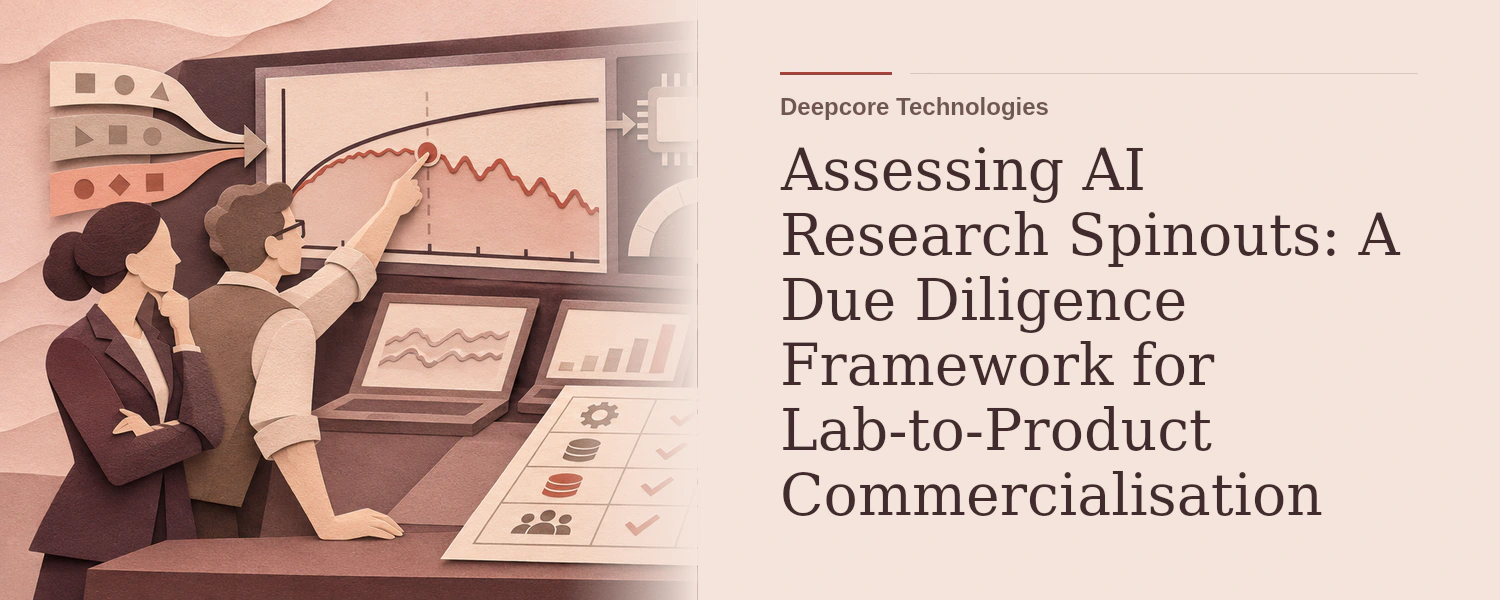
Begin due diligence by requesting an independent code audit and live replication test. Research code is frequently built on ephemeral scripts, hard-coded hyperparameter choices, and data leakage between training and validation splits. Diligence teams should require the technical founders to run inference on unseen, out-of-distribution datasets supplied by prospective enterprise partners. Track the degradation curve: does accuracy drop marginally, or does the architecture suffer catastrophic failure when exposed to incomplete fields, sensor noise, or adversarial inputs?
Examine the baseline comparisons cited in the founding team's academic papers. Researchers often compare their novel architectures against unoptimised or out-of-date baseline models. Ensure that the claimed performance delta holds when compared to well-tuned, lightweight open-source alternatives. If a 10-billion-parameter bespoke model achieves only a two percent gain over a prompt-engineered or fine-tuned standard commodity architecture, the added engineering overhead of maintaining proprietary models will rarely justify commercial investment.
Auditing Data Lineage, Governance, and Continuous Access
Algorithms are increasingly commoditised; defensible AI products rely on proprietary access to representative, high-velocity data. In an academic spinout, the data used to prove initial feasibility often carries legal, regulatory, or operational constraints that prevent commercial scaling.
First, audit intellectual property assignments and university Tech Transfer Office (TTO) agreements. Many academic datasets are gathered under research-only exemptions, academic use licenses, or hospital ethics committee (IRB) approvals that strictly prohibit commercial monetisation. A spinout that built its foundational proof on university-hosted clinical records or non-commercial open-web scrapes must demonstrate that it can either negotiate an unencumbered commercial license or rebuild its training pipeline from scratch using compliant data.
Second, evaluate the spinout's strategy for ongoing data collection. A static dataset allows a team to train a model once, but production software must adapt to seasonal variations, behavioral shifts, and regional variations. Assess whether the startup has established native integrations, hardware deployments, or proprietary software touchpoints that generate a continuous, self-reinforcing data feedback loop. Without a defensible mechanism to capture customer telemetry and edge-case failures, the spinout will face declining model efficacy as its target operational environment evolves.
Benchmarking Deployment Constraints and Inference Economics
Academic breakthroughs frequently operate under the assumption of unconstrained computational budgets. In a commercial software company, compute is a direct cost of goods sold (COGS) that dictates unit economics, gross margins, and scalability. Due diligence teams must stress-test the operational trade-offs between model complexity, hardware requirements, and operating costs.
| Assessment Dimension | Laboratory Benchmark Stage | Enterprise Commercial Stage |
|---|---|---|
| Compute Infrastructure | Multi-node high-memory GPU clusters with batch processing | Cost-optimised inference engines, mixed-precision quantization, edge accelerators |
| Latency Profile | Offline evaluation; seconds to minutes per query | Sub-second response times or strict service-level agreements (SLAs) |
| Data Pipeline | Clean, pre-processed, normalised static tensors | Heterogeneous streams, corrupt payloads, missing modalities, continuous ingestion |
| Error Tolerance | Evaluated via mean aggregate metrics (F1, BLEU, Top-1) | Deterministic guardrails, zero tolerance for hallucinations or critical silent failures |
| Maintenance Overhead | Frozen weights for research publication | Automated drift detection, active learning pipelines, regression testing suites |
Calculate the projected inference cost per active transaction. If an enterprise workflow commands a price point of fifty cents per transaction but requires sixty cents of cloud GPU compute to execute the underlying neural network, the product is fundamentally unviable regardless of accuracy. Investigate whether the founding team has executed model compression techniques, such as pruning, post-training quantization, or student-teacher distillation. A credible technical team should present a defined engineering roadmap that transitions memory-intensive research prototypes onto commodity CPU infrastructure or cost-effective edge runtimes.
Uncovering True Customer Demand and Workflow Integration
Technical founders frequently fall into the trap of technology-push commercialisation, assuming that an extraordinary computational capability will automatically generate its own market. Diligence teams must separate intellectual fascination from urgent commercial demand.
Conduct customer discovery calls that focus strictly on workflow integration rather than algorithmic novelty. In enterprise environments, AI models do not operate in a vacuum; they must integrate cleanly into legacy systems of record, enterprise resource planning (ERP) platforms, and compliance monitoring stacks. If using the spinout's software requires an enterprise customer to abandon existing tools, re-architect security permissions, or retrain operational staff, adoption friction will overwhelm theoretical efficiency gains.
Quantify the customer's cost of inaction. Inquire whether prospective design partners are allocating existing budget lines or merely running speculative proof-of-concept (POC) pilots funded by exploratory innovation grants. A pilot project funded by an innovation lab often indicates executive curiosity rather than operational necessity. Look for signed letters of intent (LOIs) or paid development contracts issued directly by business unit owners who hold profit-and-loss responsibility.
The AI Due Diligence Assessment Scorecard
To standardize evaluations across pipeline opportunities, investment committees and corporate venture teams should complete a structured diligence matrix before committing capital. Use the following diagnostic template during technical deep-dive interviews with the founding team.
Spinout Technical and Commercial Viability Checklist
- Technical Reproducibility and Robustness
- Has the codebase been audited independently of the originating university laboratory?
- Does the model maintain acceptable performance thresholds on noisy, out-of-distribution partner data?
- Are performance gains verified against modern, state-of-the-art open-source baselines?
- Data Governance and Lineage
- Has the university Tech Transfer Office granted an exclusive, worldwide, commercialisation license?
- Is training data completely free of restrictive non-commercial licenses (e.g., CC BY-NC)?
- Is there an operational mechanism to capture telemetry and edge cases in production?
- Deployment Economics and Latency
- What is the estimated cloud or edge inference cost per standard transaction at scale?
- What gross margin is achievable under realistic customer usage volumes?
- Has the team successfully validated quantized or distilled model variants?
- Workflow Integration and Market Pull
- Does the solution plug into standard enterprise platforms via robust APIs and webhooks?
- Are pilot agreements funded by operational business units rather than discretionary innovation budgets?
- Does the product deliver a measurable financial return within twelve months of deployment?